If you strip the biblical account of theological conditioning and analyze the assembly instructions of the Ark of the Covenant through the laws of physics and materials engineering, you face a shocking truth. The artifact delivered on Mount Sinai was not a liturgical object, but a highly dangerous technological device. Ancient accounts do not speak of abstract divine punishments, but of unmistakable clinical symptoms: skin burns, hair loss, sudden tumors, and instant electrocutions for anyone who dared to approach without proper equipment. When King Solomon designed the Temple of Jerusalem, he did not build a simple place of worship, but a shielded containment structure to isolate the deadly energy source residing in the Holy of Holies.
KING SOLOMON'S NUCLEAR REACTOR: WHY THE ARK OF THE COVENANT KILLED ANYONE WHO APPROACHED WITHOUT PROTECTIVE SUITS
The capacitor casing and the power source
The technical specifications reported in the book of Exodus describe the construction of a perfect electric capacitor combined with a decay chamber. The Ark was a box of acacia wood coated both inside and outside with sheets of pure gold. In electrical engineering, the alternation of two conductive layers (gold) separated by an insulating layer (acacia wood) constitutes the classic structure of a high-capacity capacitor, capable of accumulating and discharging enormous amounts of electrostatic energy. But simple electric charge is not enough to explain the thermal and luminous emission phenomena described by ancient sources.
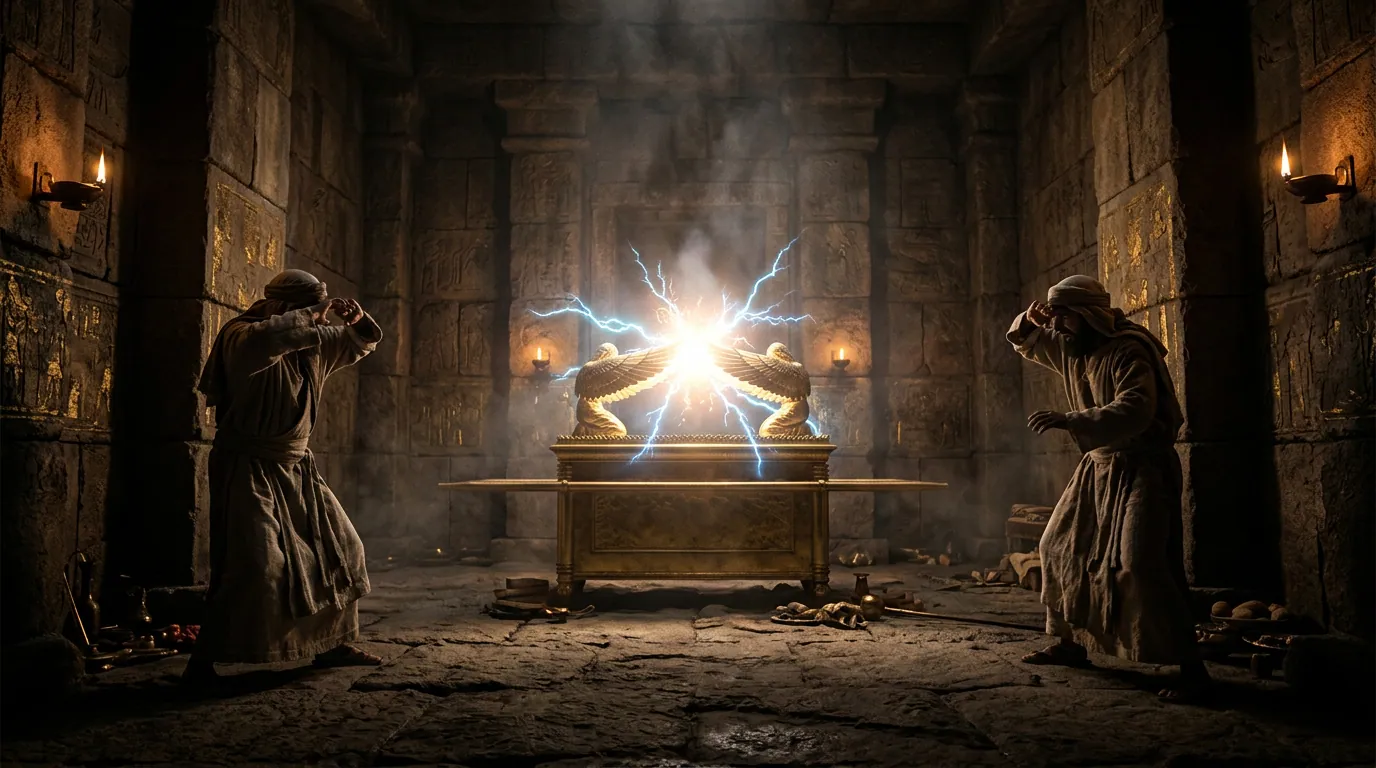
On the top of the box resided the Kapporet, the mercy seat, a plate of solid gold surmounted by two curved cherubim whose wings touched. This contact point functioned as an arc spark gap, where the energy accumulated inside was released in the form of a plasma light column, the so-called Shekhinah. What powered this continuous generator? The texts speak of a mysterious mass inserted inside the Ark, a substance that emitted heat and light without being consumed, partly identified with the jar of Manna and the inscribed stones of Sinai, whose isotopic nature suggests the presence of a long-decay radioactive element, or an active transuranic crystal provided by the Anunnaki to enable long-distance communication and tactical defense.
The Levites' biosafety protocols
The most striking clue to the radiological and high-voltage nature of the Ark lies in the very strict safety protocols imposed on the Levite caste, the only ones authorized to handle the device. The High Priest never entered the Holy of Holies dressed in common clothes but wore a true technical protective suit. The Ephod was an apron embroidered with gold threads and metal plates, while the Choshen was a breastplate containing twelve precious stones capable of changing color and reflecting the reactor's emission frequency.
The priest's footwear and garments were free of exposed metal parts to avoid involuntary energy arcs, and the main garment's fabric was made exclusively of pure linen, an excellent electrical and radiological insulator for low-penetration particles. Furthermore, the hem of the priest's robe was surrounded by gold bells and fabric pomegranates: the continuous sound of the bells signaled outside that the priest was still alive while operating inside the chamber. If the sound ceased, it meant the operator had been electrocuted or exposed to a lethal dose of radiation, and the body was extracted from outside by a rope tied to the ankle, as no one could cross the threshold of the shielded compartment without risking the same fate.
Deaths by contamination: the case of Uzzah and the plague of Ashdod
Historical chronicles record several incidents of uncontrolled exposure. The most famous case is that of Uzzah who, during the transport of the Ark to Jerusalem on an ox cart, reached out his hand to stabilize the box that was about to tip over. As soon as his fingers touched the gold coating, he was instantly incinerated by a plasma current arc. Classical historiography speaks of "divine wrath," but the dynamics describe a high-voltage arcing short circuit triggered by grounding contact with an uninsulated human body.
Even more revealing is the plague that struck the Philistines when they captured the Ark as war booty and transported it to the city of Ashdod. The city's residents and surrounding areas suddenly began developing bleeding skin ulcers, hair loss, extreme weakness, and swollen lymph nodes (described in ancient texts as "tumors"). The contaminating effect was so devastating and rapid that the Philistines, terrified by the invisible poison emanating from the box, decided to return it to the Israelites, placing it on a cart driven by unattended cows just to avoid approaching the artifact's range again.
Solomon's Temple as a containment bunker
When King Solomon decided to build the Temple in Jerusalem, the architectural priority was not aesthetics but device isolation. The Debir, the innermost room known as the Holy of Holies, was a perfect cube ten meters on each side, windowless and completely lined with gold sheets and cedar wood, to create a Faraday cage capable of containing electromagnetic emissions and preventing interference outside.
The floor and walls, meters thick, provided the necessary shielding against particle leaks. Solomon placed the Ark at the center of this bunker, positioning it under the wings of two enormous olive wood cherubim covered in gold, five meters tall, which acted as charge deflectors to channel excess energy through the Temple structure. The accumulation of ozone and heat generated by the reactor required the continuous burning of incense and special aromatic substances, used by the priests not for ritual purposes but to neutralize the metallic ionization odor of the air and perform a chemical filtering function of the cavity.
The Ark of the Covenant remained in Solomon's Temple until its power supply began to degrade or until it was transferred to an even deeper and inaccessible place before the Babylonian invasion. Its story is not the tale of a magical artifact but the detailed account of an era when humanity managed a technology of destructive power without fully understanding the laws of physics that governed it, serving as the unwitting custodian of the gods' reactor.