
Victor Arcana's new book, Hunt for the Lost Ark, has been released – buy it now on Amazon.

Victor Arcana Victor Arcana

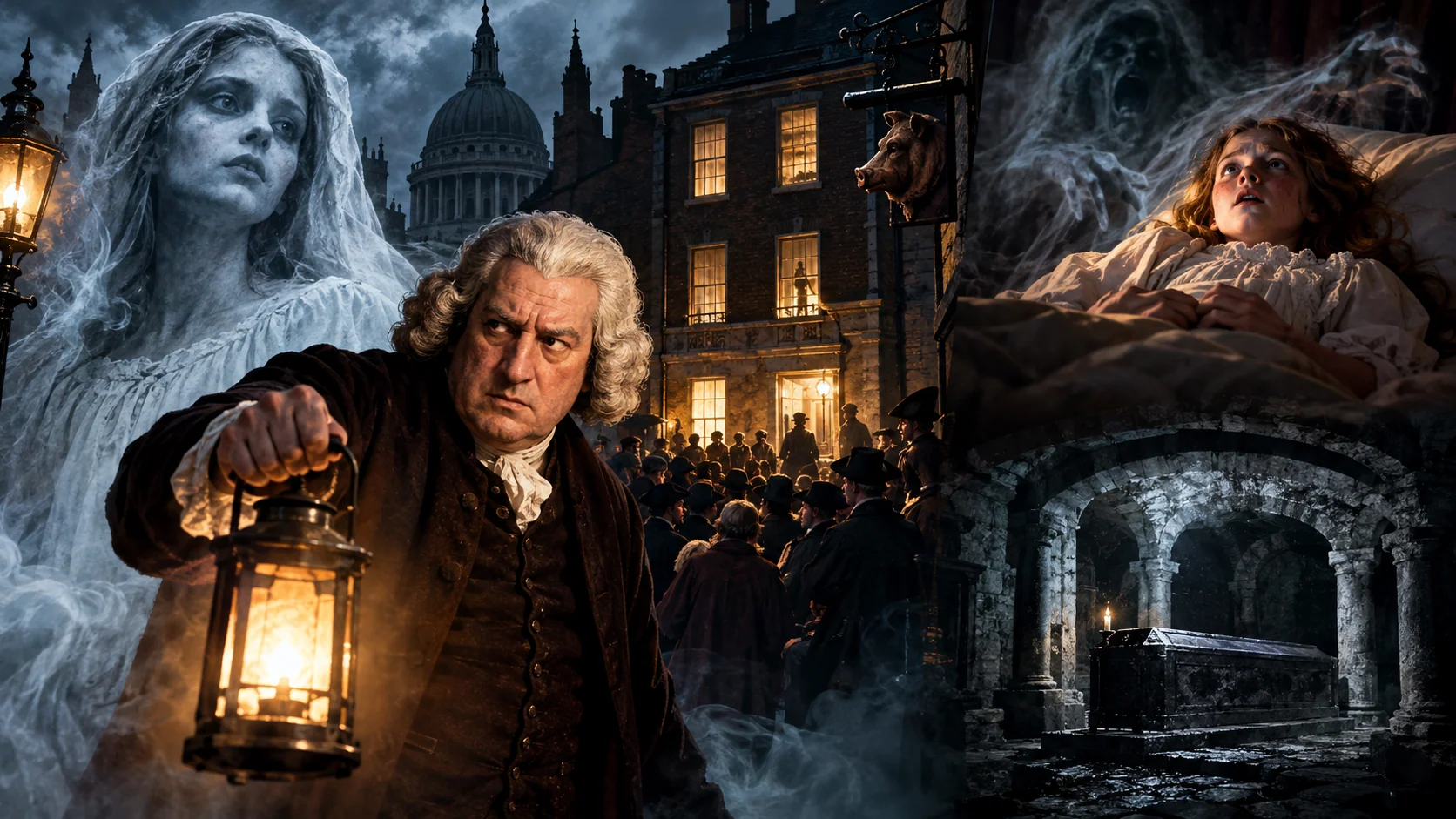
The Ghost of Cock Lane, London 1762: Johnson in the Crypt

London, 1762: a spirit knocks and accuses a man of murder. Samuel Johnson goes down into the crypt to expose it. What did he really find?

2 min read
Il fantasma di Cock Lane, Londra 1762: Johnson nella cripta

A Street Blocked by the Crowd

London, January 1762. Cock Lane is a narrow street next to Smithfield Market. Usually butchers and apprentices pass through it. In these weeks it is impassable: from morning till sunset people crowd in front of a three-story house, one room per floor, where a parish clerk lives with his wife and two daughters.

Inside, according to newspapers of the time, there is a spirit that answers questions. A ten or eleven-year-old girl, Elizabeth Parsons, is put to bed in front of visitors. Scratches and knocks are heard, and the knocks become words. The landlord, Richard Parsons, charges admission to those who want to "talk" to the ghost.

Among the curious is Horace Walpole, who on January 30 plans a visit together with the Duke of York. In a few days Samuel Johnson will also arrive, the man who compiled the great English dictionary. He will come with only one idea in mind: to understand if there is someone behind those knocks.

Who would this spirit be? And why does it accuse a living man of murder?

A Love That the Law Did Not Allow

To understand it, you have to go back a few years, to the Norfolk countryside. Around 1756-57 William Kent, a usurer and then manager of an inn and the post office in Stoke Ferry, marries Elizabeth Lynes, daughter of a grocer. After a few weeks she dies in childbirth. The baby soon follows.

The deceased's sister, Frances, called Fanny, remains in the house. She had moved to assist the pregnancy, then took care of the newborn. Kent and Fanny become a couple. But according to the canon law of the time, they could not marry: a man could not marry the sister of his deceased wife. Kent, in London, is also told that the union was impossible because Elizabeth had given birth to a living child.

In January 1759 he leaves the post office and moves to London. Fanny, who stayed with her brother, writes to him insistently until Kent lets her join him. They live as husband and wife in Greenwich, and each makes a will in favor of the other.

It is a detail that will come back. When the spirit begins to accuse, the papers of that will will already be on the table of an angry family.

The Clerk Who Needed Money

In London Kent and Fanny meet Richard Parsons at the morning prayers at St Sepulchre-without-Newgate. Parsons is the parish clerk, the lay officer who assists the services. He is considered a respectable person, but in the area, sources say, he is also known for his drinking habit and financial troubles.

He offers the couple rooms in his house on Cock Lane. Kent, who deals with money professionally, lends him twelve guineas, to be repaid one per month. Thus begins a coexistence made of debts: Parsons, according to reports, repays little and poorly, and relations sour. When Kent moves elsewhere, the matter passes into the hands of his lawyer.

The house hosts the Parsons family: the father, the mother, and two daughters. The eldest, Elizabeth, sometimes shares the bed with Fanny when Kent is away.

And in that bed, at some point, something begins to scratch.

The Scratches and the Smallpox

According to the story reported by sources, the first noises came between 1759 and 1760, while Kent was away for a wedding in the countryside. Fanny and little Elizabeth hear scraping and knocks. Mrs. Parsons attributes them to a shoemaker from the neighborhood. Fanny notes it was Sunday and the shoemaker was not working. The noises continue.

A local innkeeper, James Franzen, later claimed to have seen a white figure climbing the stairs. Parsons visited him and in turn said he had seen a ghost. These are testimonies collected later, in an already poisoned atmosphere, and must be read as such.

On January 25, 1760, Fanny falls ill. The doctor and apothecary diagnose smallpox on the 26th. Before dying, she has a will drawn up by a lawyer so that Kent inherits. The rector of St John Clerkenwell, Stephen Aldrich, a friend of Kent, reassures her. Fanny dies on February 2, 1760, and is buried in the crypt of St John.

Kent, executor, has a coffin prepared without a name. At the time of registering the burial he must give a name and gives his own. A small detail that two years later will seem suspicious.

Fanny's sisters and brothers receive half a crown each from the will. The rest goes to Kent: the share of 150 pounds from an inheritance from brother Thomas and about 95 pounds from the sale of land. Due to a defect in the sale, each beneficiary would have had to pay 45 pounds in compensation, and Kent refused to pay them.

In October 1761, brother John Lynes summons him before the Court of Chancery. Kent, meanwhile, has become a stockbroker and remarried. Parsons still owes about three guineas: Kent's lawyer recovers them by January 1762.

Anyone observing this sequence easily sees a motive. A family that feels defrauded. A debtor who owes money to a rich man. A girl subject to convulsions, ready to become the center of a scene.

But the first accusation must be heard by someone. And to hear it, a language is needed.

One Knock for Yes, Two for No

In January 1762 the noises returned to the Parsons' house, more frequent. A former tenant, Catherine Friend, had left precisely because of this. Parsons has the wooden paneling around Elizabeth's bed removed, and nothing is found.

Then John Moore enters, assistant preacher at St Sepulchre and rector of St Bartholomew-the-Great, with Methodist leanings. Convinced the spirit is Fanny, he establishes a code with Parsons: one knock for yes, two for no, scratches for displeasure. Another Methodist, Thomas Broughton, visits the house on January 5 and says he is convinced.

The questions are suggested, the answers are all one-sided. The spirit claims that Fanny was poisoned with arsenic about two hours before death, and that Kent administered it. In a version reported by one of the sources, the poison was hidden in purl, a bitter herbal beer.

The Public Ledger prints the reports. Kent, who until then knew nothing, discovers from the newspapers that he is a murderer.

You Are a Lying Spirit

On January 12 Kent goes to Cock Lane, accompanied by two doctors who had treated Fanny and by Broughton. Elizabeth is undressed and put to bed in front of everyone. Mary Frazer, a relative, wanders around the room calling Fanny. When someone asks if Kent will be hanged, the ghost answers with a knock. Kent, according to sources, calls the entity a lying spirit.

The following days are a series of sessions. On January 14 Elizabeth is tested at a certain Bray's house in front of two unidentified nobles, and the knocks are heard. On the 18th, with Kent, the apothecary, and Aldrich, the spirit refuses to answer when a candle is lit. On the 19th, Fanny's former maid, Esther Carlisle, called Carrots, is questioned: she says Fanny never spoke of poison and that the couple was happy.

On January 20, at Bruin's house on Hosier Lane, the ghost is silent and Elizabeth shows signs of convulsions. The father refuses to have her taken elsewhere. Two days later, the girl leaves Cock Lane anyway.

On January 22, at St Bartholomew's Hospital, around six in the morning three scratches are heard. Then the girl admits, according to reports, to having been awake and to having heard all the conversations, and says she is afraid for her father.

On January 23 the Lord Mayor, Samuel Fludyer, was called to intervene. He refuses to have Kent or Parsons arrested, partly because of the memory of a recent imposture case, that of Elizabeth Canning. Instead, he orders a test at Aldrich's house. Parsons asks that people familiar to the daughter be present, and the request is denied.

On January 26 Parsons publishes a letter in the Public Ledger offering his daughter for an examination, under certain conditions. Aldrich and James Penn respond harshly in Lloyd's Evening Post. The same day Elizabeth goes to Jane Armstrong's house and sleeps in a hammock.

The Public Advertiser notes that the noises now come later, at seven in the morning. On the eve of the big test, the ghost seems to have changed its schedule.

The Night in the Crypt

Aldrich assembles a committee: among the members are Bishop John Douglas, Dr. George Macaulay, Captain Wilkinson, James Penn, John Moore, and Samuel Johnson. Johnson is the best-known name.

On the night of February 1, 1762, Elizabeth is put to bed under the supervision of some ladies. The ghost promised one thing precisely: if the investigators go down into the crypt of St John, where Fanny lies, it will knock on her coffin. The committee goes down around one o'clock. Nothing is heard.

Johnson puts the conclusions in writing. In the report, published in the February issue of Gentleman’s Magazine, he writes that no evidence of supernatural power manifested and that the girl has some skill in producing or imitating a particular noise. Between two and three in the morning Elizabeth returns home with her father.

It was the day before the second anniversary of Fanny's death. The real question, for Londoners, remains another: if it is a hoax, who is behind it?

The Piece of Wood

The following days are the longest part of the investigation. Elizabeth is examined in a house on the Strand from February 7 to 10 and then at Covent Garden from the 14th. They put her in a hammock, with hands and feet well extended. The noises stop when her hands remain outside the bed.

The ghost is silent for two nights. The girl is told that if by Sunday, February 21, nothing more is heard, she and her father will end up in Newgate. The maids then see her hide a small piece of wood (sources do not agree on the exact moment: one places it already on the night of February 1). Observers conclude that she produces the knocks under her father's pressure, and let her return home.

On February 25 a voice in the newspapers claims that Fanny's body has been moved. To deny it, Kent, Aldrich, the undertaker, the church clerk, and the sexton go down into the crypt and open the coffin: they see the body. A pamphlet favorable to Kent, "The Mystery Revealed," probably by Oliver Goldsmith, circulates in those days.

Moore then publishes a retraction: the knocks were a trick, but Kent had not behaved as a guilty party.

The Pillory of Parsons

Kent sues for conspiracy. The defendants are Moore, Richard Parsons, his wife, Mary Frazer, and Richard James, the merchant who had released the news in the Public Ledger. The trial opens on July 10, 1762, at Guildhall, presided over by Lord Chief Justice William Murray, the future Earl of Mansfield.

Kent, Franzen, the maid Carrots, and the doctors testify. For the defense, those who had treated Elizabeth, the carpenter, and Catherine Friend testify. Murray receives a letter from Archbishop Thomas Secker in favor of Moore, puts it in his pocket without opening it, and says it cannot concern the case. After about ninety minutes of summary, the jury takes fifteen minutes to declare all guilty.

The sentence arrives on January 27 and 28, 1763. Moore and James agree to pay Kent about 588 pounds. Parsons is sentenced to two years in prison and three exposures to the pillory at the end of Cock Lane. His wife gets one year, Mary Frazer six months at Bridewell with hard labor.

On March 16, March 30, and April 8 Parsons goes up on the pillory. The crowd, unlike what happened with other convicts, does not cover him with insults: partly they pity him and collect donations for him.

The Ghost Remains Ownerless

The case immediately becomes a weapon. Anglicans and Methodists accuse each other: Methodists, more willing to believe in the supernatural, are accused by others of wanting to prove the existence of ghosts. Charles Churchill published in 1762 the satirical poem The Ghost, where Johnson appears, under the name Pomposo, as a gullible person. William Hogarth cites him in a print of the same year.

Johnson was actually the least credulous of the group. He had a precise rule in mind. He told Boswell he would believe in a spirit only if it revealed a fact that no one could know and that could be verified. At Cock Lane the ghost revealed nothing.

The case has been studied until today. Charles Mackay, in 1841, wrote that the method of the deception was never explained. Andrew Lang, in 1894, called it a proverb of shameless fraud whose story, however, remained a mystery. Colin Wilson, in 1981, argued it was a poltergeist like hundreds of others and criticized those who dismissed the neighbors' testimonies.

A ten-year-old girl, an indebted father, a will, a committee of illustrious men. The judicial truth is clear. But did Elizabeth do it all alone or was she guided? And the neighbors' testimonies, discarded in court, what had they really heard?

THE RATIONAL EXPLANATION

Johnson's committee concluded that Elizabeth produced the knocks: they stopped when her hands remained outside the bed, and the maids saw her hide a piece of wood. A court convicted those who had fabricated the accusation of conspiracy. Colin Wilson, in 1981, saw it instead as a poltergeist, but for historians it remains a hoax.

IF YOU GO

Cock Lane is a short street next to Smithfield Market, in London, and here stood the Parsons' house. It is reachable on foot from the market. There is nothing left to visit from the time: it serves to imagine the crowd of 1762.

Sources