
Victor Arcana's new book, Hunt for the Lost Ark, has been released – buy it now on Amazon.

Victor Arcana Victor Arcana

Piprahwa Vase: Buddha's Bones in a 15-Centimeter Urn?

In 1898 an engineer digs a hill in India and finds an urn with the name of the Buddha. But the inscription is two centuries too late, and a forger was nearby.

2 min read
Vaso di Piprahwa: le ossa del Buddha in un'urna di 15 centimetri?

The Card

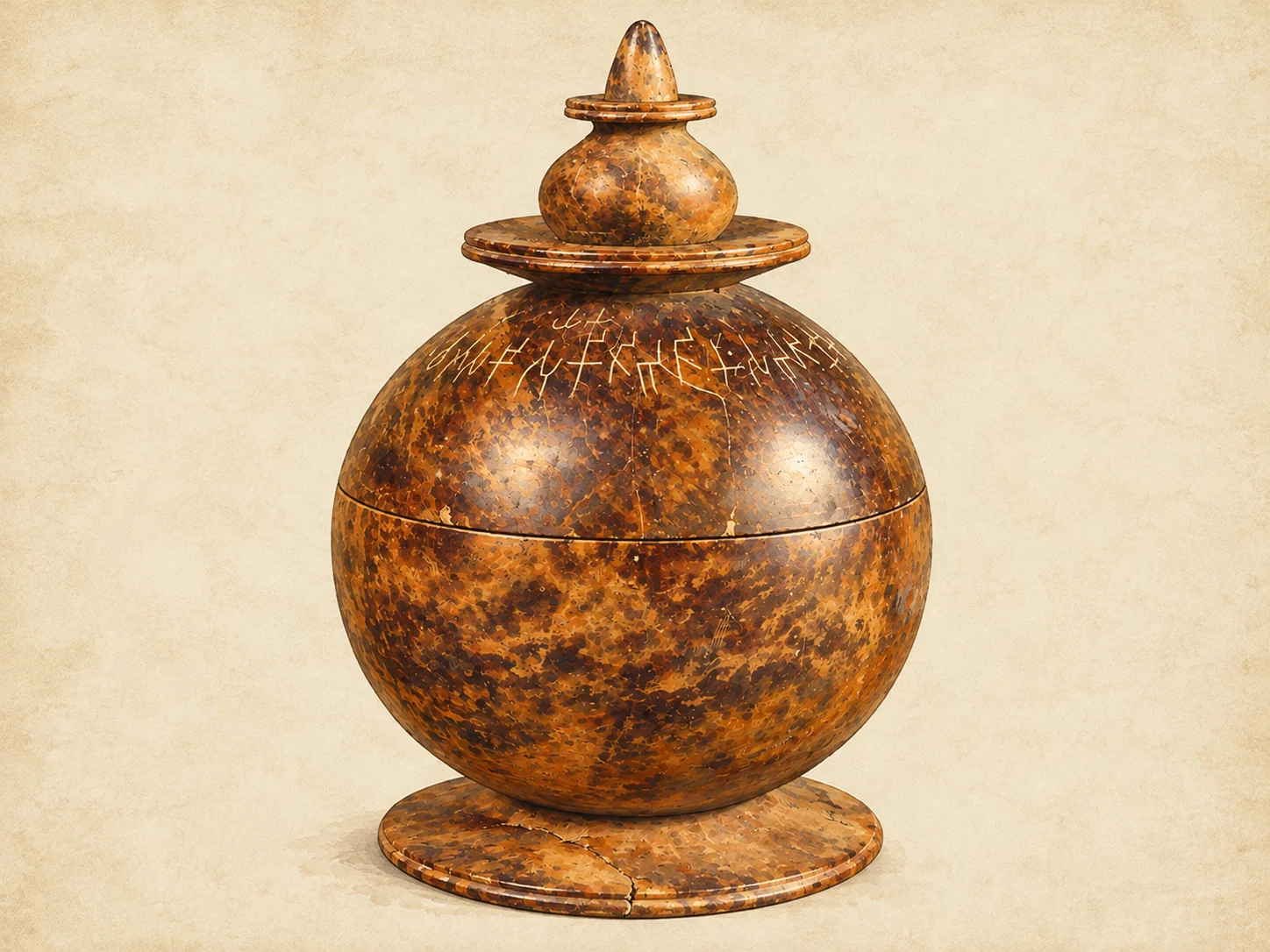
  • What it is: small reliquary vase with lid, with a Brahmi script inscription naming the relics of the Buddha and the Sakya clan

  • Where and when it was found: Piprahwa stupa (Uttar Pradesh, India, near the Nepal border), January 1898, by William Claxton Peppé; it was in a sandstone box under 18 feet (about 5.5 m) of masonry, along with four other reliquaries

  • Dating: around 3rd century BC (Maurya period)

  • Material and measurements: steatite; height 15.2 cm, diameter 10.2 cm

  • Where it is today: Indian Museum, Kolkata (inventory no. 19737A&B)

  • Authenticity: considered authentic by most scholars; there remains a dissenting opinion attributing the inscription to the forger A. A. Führer

Eighteen Feet of Bricks

Piprahwa, Northern India, just a step from the Nepal border. January 1898.

Workers have been digging for weeks inside a hill that is not a hill. Beneath the earth and bushes is a dome of baked red bricks, almost forty meters wide. They descend through the masonry: one meter, two, five. Only bricks, bound with clay. At eighteen feet deep, about five and a half meters, the pickaxes hit something different. A stone slab.

Leading the excavation is not an archaeologist. William Claxton Peppé is an engineer, born in India in 1852, educated in Aberdeen, returned in 1873 to help his father on the Birdpur estate. Since the early 1880s he has managed it. The famine of 1896-97 left his peasants without work, and that mound at the edge of the property is a way to give them some. There is more to it. In 1896, less than twenty kilometers away, the Lumbini pillar reemerged, marking the place where the Buddha was born. Suddenly the whole region is land to be excavated.

Under the slab is a box carved from a single block of sandstone. Peppé will estimate its weight: 1,537 pounds, almost seven hundred kilos. The lid is cracked in four places. But it has not moved.

What has a seven-quintal stone been protecting for more than two thousand years?

Five Vases in the Box

The box is opened around January 18, 1898. Four witnesses are present, three of whom bear the surname Peppé.

Inside are five containers, none taller than eighteen centimeters. Peppé lists them two days later in a letter: two stone vases, a small jug of the type called lota in India, a stone box, a crystal cup. Four are made of steatite, the soft soapstone.

Around and inside the vases, the treasure. Gold and silver sheets worked in relief. Gold leaf discs with Buddhist symbols. Pearls. Drilled beads. Carnelian, amethyst, topaz, garnet, coral, rock crystal, cut into tiny shapes. The most cited count speaks of about 1,800 pieces; other inventories report fewer.

And then, mixed with the jewels, fragments of bone and ash.

Peppé followed the advice of Vincent Smith, a British official and historian of ancient India, who in October 1897 had visited the mound and recognized it: a very ancient Buddhist stupa, perhaps from the time of Emperor Ashoka. Now Smith writes to him from Gorakhpur with a precise recommendation. Look for inscriptions.

On January 19, Peppé finds one.

A Scratched Line on the Lid

It is on the smaller of the two round vases. Fifteen centimeters high, ten in diameter. Someone scratched a line of characters less than five millimeters tall on it.

The script is Brahmi, the same as Ashoka's edicts. The language is a local Prakrit. Peppé copies it in pencil as best he can and sends the sheet to Smith. The note is dated "19.1.98".

Smith immediately recognizes three words: relics, Buddha, Blessed. Only later does he identify a fourth that had escaped him: sakiyanam. Of the Sakyas.

The Sakyas are the clan in which Siddhartha Gautama was born. Buddhist texts tell that after the cremation, the Buddha's remains were divided into eight parts among the ruling families who claimed them. One went to the Sakyas of Kapilavastu, his people.

In February, the reading from Vienna arrives by Georg Bühler, professor of Indian philology and translator of the Laws of Manu. According to him, the text essentially says that this deposit of Buddha's relics is a gift from the Sukiti brothers, together with their sisters, children, and wives.

The news crosses the oceans; the New-York Tribune also writes about it. An estate administrator has found the Buddha's bones.

Then someone looks more closely at the dates.

Two Centuries Too Late

The Buddha died, according to a widely followed chronology, around 480 BC. The vase, according to the museum that holds it, is from the 3rd century BC. Ashoka reigned roughly from 268 to 232 BC. The Pakistani scholar Ahmad Hasan Dani, comparing the letters with those of the imperial edicts, placed the inscription precisely in the 3rd century.

Between the funeral pyre and the scratched line on the lid there are at least one hundred and fifty years. Perhaps more than two hundred.

How can an urn hold the ashes of a man who died generations before someone engraved it?

And there is a second crack, thinner. The grammar of the sentence allows more than one reading. In 1905 John Fleet, epigraphist and secretary of the Royal Asiatic Society, proposed to invert it: the relics would not be of the Buddha but of his relatives, the Sukiti brothers with their families. Criticism later pushed him to abandon the idea, and in 1906 the translation by the French Auguste Barth became the reference. The Calcutta museum card still today shows the two readings, Bühler and Fleet, side by side.

But the hardest blow to the discovery comes from a man who, at that time, was camped less than thirty kilometers away.

The Shadow of Dr. Führer

His name is Alois Anton Führer. German, curator of the Lucknow museum, archaeologist of the colonial government. His name is linked to the Lumbini pillar, and since December 1897 he has been digging at Sagarwa, just beyond the Nepalese border.

On January 19, the same day as the inscription, he writes to Peppé from what he calls "Kapilavastu Camp" and asks him to check if there are writings on the finds. On January 28, Smith and Peppé visit him at the camp.

A few months later his career collapses. It is discovered that he sent false Buddha relics to a Burmese monk, U Ma: one was a horse tooth. He described ruins never seen, copying them from someone else's report. He invented inscriptions. On September 16, 1898, he resigns. Six days later it is Vincent Smith himself, with an official assignment, who seizes his papers. In 1912 the Indologist Heinrich Lüders will recognize forged Brahmi inscriptions also in the Lucknow museum.

A forger of Brahmi inscriptions and Buddha relics, less than thirty kilometers from the vase that should contain them. The suspicion is inevitable, and lasts more than a century.

Then there is a death. On April 8, 1898, Georg Bühler, who had been Führer's teacher, drowns in Lake Constance. Contemporaries mostly speak of an accident. Someone later hypothesized a suicide linked to the scandal. It remains a hypothesis.

Did Führer get his hands on that vase?

The Family Letters

The most solid answer comes in 2008, from the Peppé papers. British historian Charles Allen studies William's correspondence, now at the Royal Asiatic Society in London, and reconstructs those days one by one in the book The Buddha and Dr Führer.

The sequence is tight. Opening of the box around January 18. Inscription discovered on the 19th. Copy sent to Smith the same day. On the 24th Führer comments on the reading by letter, without having the vase in front of him. He announces his arrival at Piprahwa only at the end of February: at least five weeks later. For Allen, he had no way to touch anything before the text was known.

In the documentary Bones of the Buddha, broadcast in 2013, Allen brings German epigraphist Harry Falk to Calcutta. According to Allen's account, Falk judges the inscription authentic and finds a term for "remains" that does not appear elsewhere. He also measures the box: the dimensions would correspond to the unit of measure used under Ashoka, and the pink sandstone dotted with black would be the same as the Lumbini pillar.

Not everyone gives up. Allen himself reports that Michael Willis, a British Museum scholar, in a 2012 review probably defined the inscription as a Führer forgery.

But if the urn is authentic and has Ashoka's age, the problem of the dates remains intact. Unless there is something else under the box.

Under Peppé's Floor

Early seventies. Archaeologist K. M. Srivastava, of the Archaeological Survey of India, returns to Piprahwa and does what Peppé had not done. He goes deeper.

Below the level of the box he finds two small chambers of baked bricks, each about eighty centimeters square and thirty-five deep. In each is a steatite casket. No gold, no gems. Only bone fragments: twelve in the larger casket, ten in the smaller. Twenty-two in total. Next to them, broken plates of ceramics that archaeologists date to the 5th century BC.

The stupa, then, grew in three phases. A first clay mound, nineteen meters wide. Then the large brick dome from Ashoka's time. Finally a squared base, from the Kushan era.

From here comes the hypothesis supported by Allen. The Sakyas bury their share of remains in a poor tomb. Two centuries later comes Ashoka, the emperor who according to Buddhist tradition reopened the ancient tombs to redistribute the relics throughout the empire. He has the stupa rebuilt, adds the gems, the box, and a new urn. With a line declaring what is inside.

The inscription would not be the signature of someone who saw the Buddha burn. It would be the label of those who, generations later, rearranged his tomb.

It is a coherent hypothesis. It is not proof. And it opens another dispute.

The Contested City

In the monastery next to the stupa, excavations yield more than forty terracotta seals and a vase. They bear writings from the 1st and 2nd centuries AD. One names the community of monks "of the great Kapilavastu".

Kapilavastu is the city of the Sakyas, the one where according to tradition Siddhartha grew up as a prince. For many Indian scholars those seals say it was here. Other archaeologists place it at Tilaurakot, in Nepal, following the accounts of Chinese pilgrims Faxian and Xuanzang. The dispute is not closed.

Meanwhile the relics disperse. In 1899 the bones found by Peppé are handed over to an envoy of Chulalongkorn, king of Siam: they were requested by a monk of royal blood, Jinavaravansa. They end up in the Golden Mount of Bangkok, and other portions in Burma and Ceylon. The box, the five vases, and most of the jewels go to the Calcutta museum. Peppé keeps a part of the jewels, between a fifth and a sixth, recorded as "duplicates".

It is those duplicates, 127 years later, that reignite everything.

At Auction, in Hong Kong

Early 2025. Chris Peppé, great-grandson of William, a television director in Los Angeles, and two other descendants put over three hundred family gems up for sale at Sotheby's. The auction is set for Hong Kong on May 7. The estimate exceeds one hundred million Hong Kong dollars, about thirteen million US dollars.

The Indian government sends a legal warning. It claims those stones belong to the relics, and accuses the auction house of participating in a continuing colonial exploitation. Scholars and Buddhist communities protest. Sotheby's postpones.

Two months of negotiations follow. Then the Indian industrial group Godrej buys the collection, at an undisclosed price, and on July 30, 2025, the return of the gems to India is announced. On January 3, 2026, in New Delhi, an exhibition opens displaying them together with the sandstone box, the Calcutta reliquaries, and the bones found in the seventies. According to the organizers, it is the first time since 1898 that the contents of that pit are reunited.

Everything, except one thing. Certainty.

No one can say to whom those bone fragments belonged. Peppé's are kept in temples in three countries. The inscription has been read in at least two ways. The urn's date does not match that of the death it should hold.

What remains is a fifteen-centimeter-high vase, a line of scratched letters, and a twenty-three-century-old question: did the person who engraved the Buddha's name on that stone really know what they were sealing inside?