
Victor Arcana's new book, Hunt for the Lost Ark, has been released – buy it now on Amazon.

Victor Arcana Victor Arcana

October 11, 1492: Columbus sees a light in the darkness of the ocean

Four hours before the cry “Land!”, Columbus notes a flicker rising and falling on the sea. The coast is still far away. What did he see?

2 min read
11 ottobre 1492: Colombo vede una luce nel buio dell'oceano

Ten o'clock in the evening, aboard the Santa María

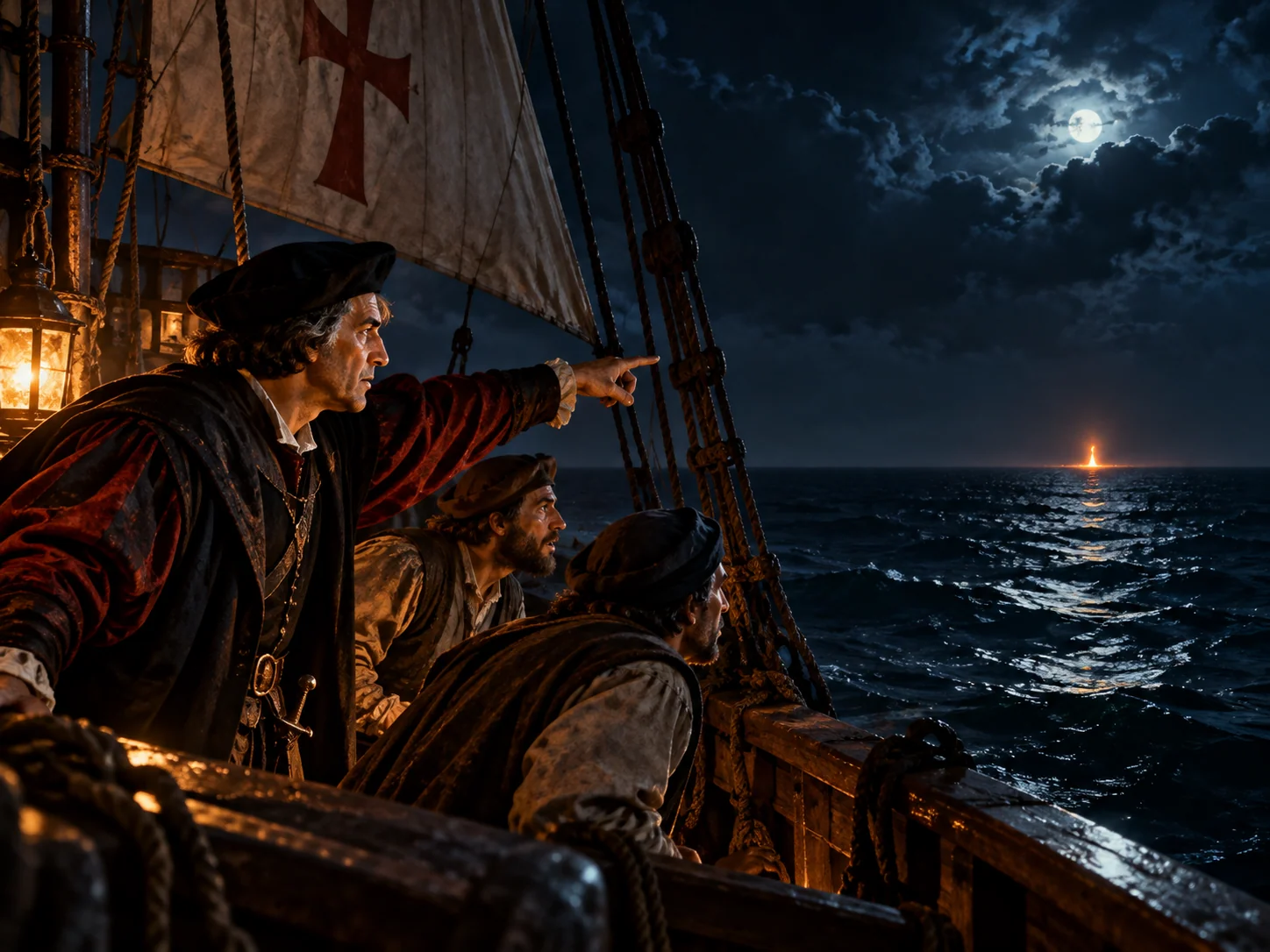
Atlantic Ocean, aboard the Santa María. Thursday, October 11, 1492, ten o'clock in the evening.

Christopher Columbus is on the sterncastle when he notices something in the dark: a light, so small that he does not dare call it land. He calls Pero Gutiérrez, an official of the king's household. He sees it too. Then he calls Rodrigo Sánchez de Segovia, the fleet inspector: from where he is, he cannot see anything.

The light appears once or twice more. In the ship's log, which we know from the summary by Bartolomé de las Casas, it is described as a wax candle rising and falling.

Four hours later, at two in the morning, from the Pinta the sailor Rodrigo de Triana spots the coast, two leagues away. It is Guanahani, in the Bahamas.
A candle 35 miles from the coast

The numbers don’t add up here. The ships were sailing fast: at ten o'clock in the evening, calculated in 1927 by scholar L. T. Gould, the land was still about 35 miles away. Too far for the flicker of a candle.

Las Casas thought of torches lit by the natives. Others suggested bioluminescent marine worms, but a 2000 study objects that their lunar cycle does not match that night. Some have spoken of a flying object, without any proof.

The prize of 10,000 maravedís

One detail remains. Whoever first spotted land was entitled to 10,000 maravedís per year. According to historian Samuel Eliot Morison, Columbus claimed it, precisely in the name of that light.

A real flicker, or a light it was convenient to see?

Sources