
Victor Arcana's new book, Hunt for the Lost Ark, has been released – buy it now on Amazon.

Victor Arcana Victor Arcana

Burned alive, cursed the Pope and King: dead within the year?

Arrested at dawn on a Friday the 13th, tortured, burned alive. Then, within a few months, the Pope and the king died. And a secret parchment waited 687 years.

2 min read
Bruciato vivo, maledisse Papa e Re: morti entro l'anno?

At dawn on a Friday

Paris, Friday, October 13, 1307, at dawn. Throughout France, on the same day, the king's men arrested the Templars. Among them was the Grand Master himself, Jacques de Molay, captured with the brothers of the Order's house in Paris in a dawn raid.

Tomorrow, October 13, it will have been 719 years since that roundup. It is the day when the fall of the most powerful chivalric order of Christianity began. And, according to a legend that spans centuries, it is also the beginning of a curse that would strike a pope, a king, and an entire dynasty.

The legend is well known: from the stake, the Grand Master supposedly called the pope and the king before the tribunal of God within the year. What few know is how much the real facts resemble it.

A month of silence

The trap had been carefully prepared. On September 14, 1307, Philip IV of France, called the Fair, had sent secret orders to his bailiffs and stewards: prepare the arrests and carry them out a month later, all at once. For a month the secret held.

The Templars were born after the First Crusade to protect pilgrims heading to Jerusalem. In two centuries they had become more than a religious order: castles, lands, churches, and a financial network that crossed Europe. The Crusades in the Holy Land ended in 1291 with the fall of Acre. The knights no longer had a war to fight, but they still had a treasure. And a king full of debts was watching them.

The official accusation was heresy. The testimonies collected by the inquisitors were very serious: denying Christ during entry into the Order, spitting on the cross, obscene kisses between brothers. In August 1308, the worship of an idol was added. In the end, the charges against the Templars reached 127.

Twenty-two meters of confessions

From October 19 to November 24, 1307, the inquisitors interrogated 138 Templars in Paris. The youngest was 16 years old, the oldest 80. Almost all admitted at least one of the charges against them.

Those confessions still exist. They are written on a scroll 22 meters long, made up of 44 parchment sheets sewn one after the other, kept at the National Archives of France and exhibited to the public in Paris between 2023 and 2024. Twenty-two meters of admissions, almost all in Latin. Many, according to historians, obtained through torture or the threat of torture: in Poitiers, in 1308, some Templars declared they had been tortured or threatened.

Jacques de Molay also confessed, in October 1307, before the University of Paris: he admitted to having denied Christ and trampled the cross. In December he retracted before the cardinals. Then he returned to confess. Then he retracted again, in November 1309, before the papal commission. A man who had spent more than forty years in the Order, having joined in 1265, and who now oscillated between fear and honor while his world collapsed.

The forgotten parchment

And here comes the document that changes history. Between August 17 and 20, 1308, at Chinon Castle, three cardinals sent by Pope Clement V interrogated the heads of the Order, including Molay, who was heard last. According to the reading of the Italian paleographer Barbara Frale, the parchment recording those interrogations contains the papal absolution of the Grand Master and the other leaders from the charge of heresy.

That parchment remained buried in the Vatican archives for centuries. Frale found a copy in September 2001. In 2007 the Vatican published it in an edition of only 799 copies, the volume Processus contra Templarios.

But in 1308 no one outside that room knew it. And the trial went on as if Chinon had never existed. On May 12, 1310, outside Paris, 54 Templars were burned at the stake. On March 22, 1312, at the Council of Vienne, the bull Vox in excelso suppressed the Order. In May, the bull Ad providam transferred its assets to the Hospitallers.

The words from the stake

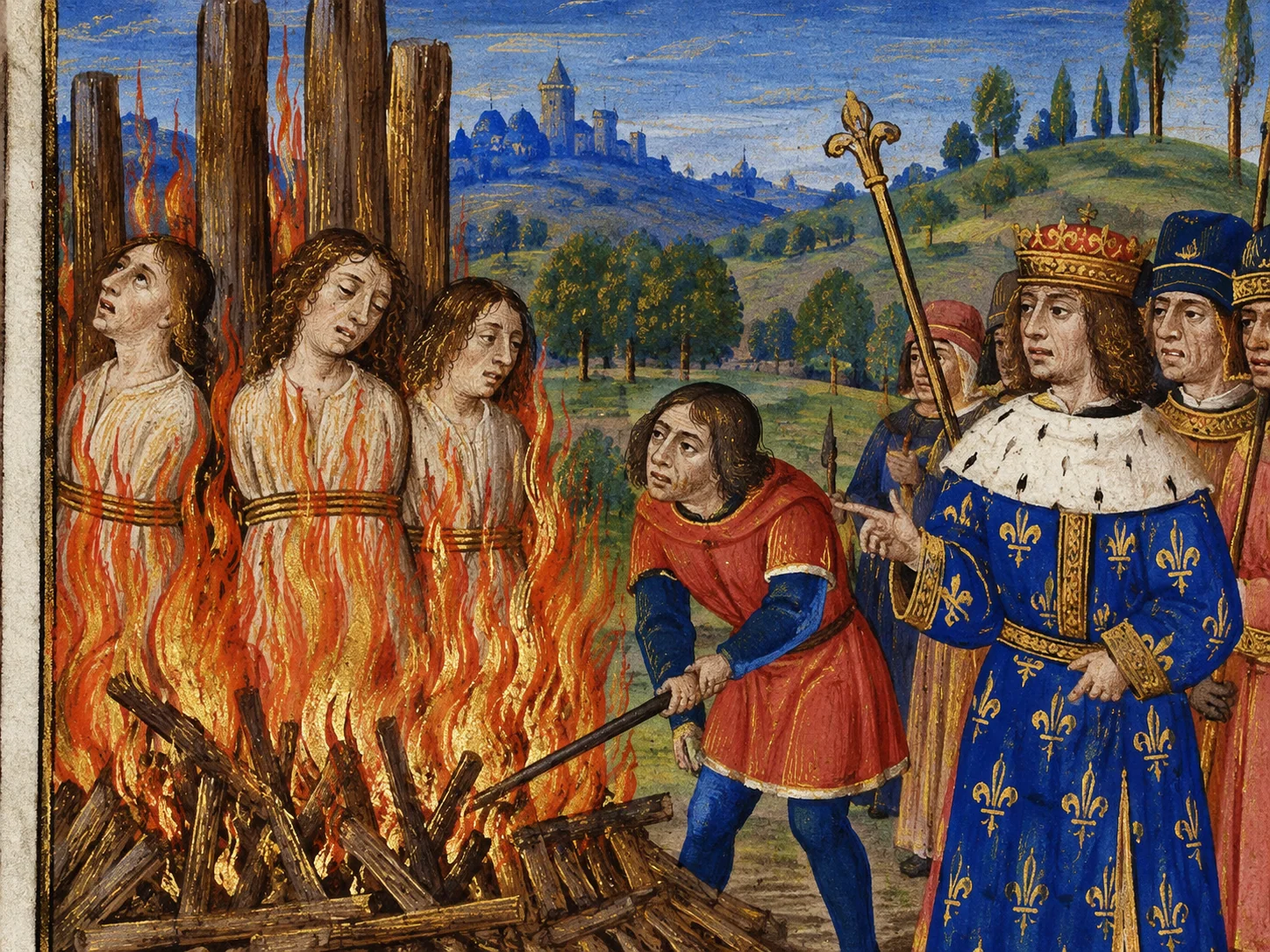
The Grand Master remained. In March 1314 Jacques de Molay and Geoffroi de Charney, preceptor of Normandy, were brought in public to hear the sentence of life imprisonment, the same imposed on two other heads of the Order. Instead of remaining silent, they retracted everything publicly. By law they were repeat heretics. They were burned the same day on the Île aux Juifs, a small island in the Seine at the end of the Île de la Cité. The most cited date is March 18, taken from the chronicle of Guillaume de Nangis; historian Alain Demurger considers March 11 more likely.

There was a witness. The king's cleric Geoffroi de Paris recounts that Molay stripped down to his shirt without showing fear, asked to be able to join his hands to pray and to be turned towards the Virgin. And he said that God would avenge their death.

No explicit curse in his chronicle. But a warning. The Vicentine chronicler Ferreto de' Ferreti reported a similar story, attributing it, however, to a Neapolitan Templar who would have called the pope and the king to account. In the sixteenth century, historian Paolo Emilio fixed the version we know: Molay who from the fire summons Clement and Philip before the tribunal of God.

A year of deaths

And then this happened. On April 20, 1314, a few weeks after the stake, Pope Clement V died in Roquemaure. According to a story, during the funeral vigil a lightning bolt struck the church where the body lay and the fire almost completely destroyed it. The pope who had dissolved the Order also died in the flames.

That same year the court of Philip the Fair was overwhelmed by the Tour de Nesle scandal: two of his daughters-in-law, Margaret and Blanche of Burgundy, were accused of adultery and the alleged lovers, the d'Aunay brothers, were tortured and executed. Then it was the king's turn. Struck by a stroke during a hunt in the Halatte forest, Philip IV died in Fontainebleau on November 29, 1314. He was 46 years old. In Germany, according to chronicles, his death was read as a punishment for the destruction of the Templars.

Within the year, as the legend wanted. Both.

The dynasty that ended

But there is a more disturbing way to read all this. The curse, if it exists, did not stop at the king.

Philip the Fair left three sons, all three destined for the throne. Louis X died on June 5, 1316, after just two years of reign. Philip V died on January 3, 1322. Charles IV died on February 1, 1328. None of the three left a living male son. In fourteen years from the stake, the direct line of the Capetians, who had ruled France for over three centuries, ended. The throne passed to the Valois, and the contest for that crown opened the way to the Hundred Years' War.

Historian Colette Beaune says it clearly: the legend of the curse was born precisely from the misfortunes of the dynasty. First came the deaths, then the prophecy. Writer Maurice Druon made it immortal with the cycle of The Accursed Kings, written between 1955 and 1977, where the Grand Master shouts from the stake the condemnation up to the thirteenth generation. And this is the most uncomfortable reading: for contemporaries there was no need to invent anything. It was enough to count the dead.

However, there is a true detail that no novel has surpassed. While Molay was burning, in the pope's archive there already existed a document declaring him absolved. That parchment remained silent for almost seven centuries. When Barbara Frale found it, the Grand Master had been ashes for 687 years.