
Victor Arcana's new book, Hunt for the Lost Ark, has been released – buy it now on Amazon.

Victor Arcana Victor Arcana

Oak Island: the treasure pit that killed 6 men

A pit discovered in 1795 swallowed excavations, money, and six lives. What does Nova Scotia's Money Pit really hide?

2 min read
Oak Island: il pozzo del tesoro che ha ucciso 6 uomini

The hole in the woods

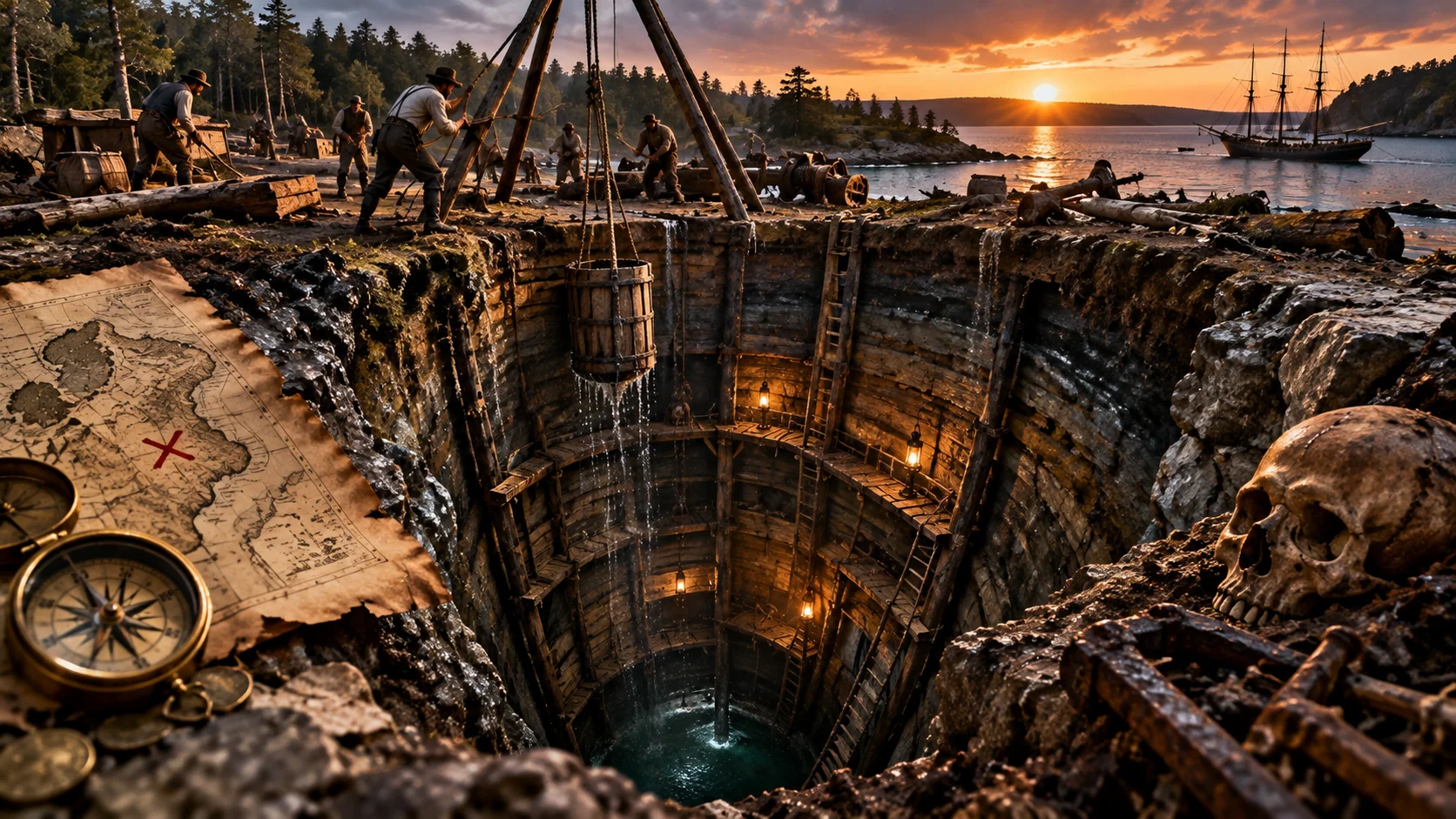
Summer of 1795. A man named Daniel McGinnis walks on an island in Nova Scotia, Canada. He is looking for a suitable place for a farm. On the ground, he finds a depression. He calls John Smith and Anthony Vaughn. They start digging.

About sixty centimeters below the surface, they hit stone slabs. They dig further. They reach about nine meters. Then they stop. Sources give only one reason: a "superstitious fear".

There is also another, later version. Here the protagonists are four boys and the discovery happens during a fishing trip. The date and names change depending on who tells the story. The pit, however, remains the same. They call it Money Pit, the "money pit".

Since that day, they have been digging inside for over two centuries. The count, so far, is six dead. No treasure.
The island of the pit

Oak Island, the island of oaks, is a strip of land off the coast of Nova Scotia. It has a pit, and around the pit a story that has grown for two centuries.

Later accounts say that in the excavation there were oak platforms every three meters. Older sources, however, speak only of "marks." This is the first point to keep in mind: the legend is more orderly than the documents.

Around 1802 the Onslow company arrives. The men go down to about twenty-seven meters. They find layers of coal, mastic, and coconut fiber. They also find a stone with inscriptions. Then the pit floods. The water reaches about eighteen meters.

Who fills a hole with coconut fiber, in Nova Scotia, in the eighteenth century? And why does the pit flood every time the excavations go deeper?

The men of the pit

The Truro company works between 1849 and 1851. They use a drill. At about thirty meters the tip encounters "metal in pieces," fragments of metal, as sources report. The pit floods again. It is hypothesized that the original bottom collapsed and that the supposed treasure fell further down. The company fails in 1851.

In 1861 a boiler powering a pump explodes. This is the first death. In 1897 Maynard Kaiser falls and dies. This is the second.

Then silence. Then 1965. Robert Restall, his son, Karl Graeser, and Cyril Hiltz die in the pit from hydrogen sulfide fumes. Another man, Andy DeMont, is saved. That year Reader's Digest publishes an account of Restall's excavation.

With the four victims of 1965, the total reaches six. In popular versions there is a phrase that recurs: seven men must die before the treasure is found. The phrase is a legend repeated for over a century. It is not a document. But on site, six deaths have occurred, and the count remains open.

The evidence

The first evidence is the coconut fiber. In 1851 it was reported under the beach of Smith's Cove. From here comes the idea of an artificial tunnel that brought seawater into the pit, like a trap. The Smithsonian concluded that the material is indeed coconut fiber. This does not prove that a tunnel exists.

The second is the stone with inscriptions, called the "90-foot stone." It is first mentioned in an article of the Halifax Sun and Advisor of July 2, 1862, based on a letter from J. B. McCully. Then the stone follows a less glorious path. It ends up in the fireplace of the Smith family. In 1909 Bowdoin sees it and cannot read any symbol. Later it is used as a beating stone in a bookbinding shop in Halifax and abandoned in 1919. After 1919 sources no longer follow it, and only readings remain of the inscription.

The third is a fragment of parchment made of sheepskin, recovered in 1896. It bears two letters in India ink, "vi" or "wi." That's all.

In 1931 William Chappell finds at about thirty-nine meters an axe, a grapnel anchor, and a miner's pick from Cornwall. In 1971 the Triton Alliance digs a seventy-two meter pit down to the rock. Images from an underwater camera would show possible chests and human remains. No independent verification has confirmed them.

The words on the stone

If the stone is lost, who read it? Here the mystery becomes a game of translations.

In the 1893 prospectus Liechti read it as: "Ten feet below are buried two million pounds sterling." After the writer Edward Rowe Snow introduced symbols in 1949, a reading circulated that spoke of forty feet. At the end of the seventies Barry Fell recognized Coptic symbols and a text about plague and prayer. Academics do not consider it credible. Daniel Ronnstam sees the dual cipher of Francis Bacon. His is a self-published source.

Four readings, four different treasures. No one can verify them because the stone disappeared from sources in 1919.

Pirates, Templars, queens

Who filled the pit? The answer changes with every book.

The oldest is Captain Kidd. Then Blackbeard. Then the Templars and the Freemasons: according to Steven Sora they would have hidden here the Grail or the Ark of the Covenant. Penn Leary, in 1953, proposes Francis Bacon and the Rosicrucians. Others speak of Marie Antoinette's jewels, escaped to London and then to Nova Scotia, but the story is undocumented. Crooker evokes the Incas, the Templars, or the Freemasons. Others think of British troops who in 1762 would have stored the Cuban loot here. Godwin thinks of French engineers hiding the treasure of the Louisbourg fortress.

They are all hypotheses. None has proof.

Then there are objections, and they weigh. In 1995 the Woods Hole Oceanographic Institution attributed the flooding to a natural interaction between the island's freshwater table and the tide. The so-called "five finger drains," long considered proof of an artificial drainage system, are now considered remains of an ancient salt marsh. Joe Nickell proposes a karst sinkhole, with fallen trees mistaken for platforms. Joy Steele thinks of a tar furnace.

According to this reading, the pit is a natural hole and the legend grew with the excavations. It is the explanation treasure hunters like the least.

Why the island does not give up

In 1965 Robert Dunfield digs with a seventy-ton crane down to about forty-one meters. In 2006 brothers Rick and Marty Lagina buy half of the company managing the searches. Since 2014 the series "The Curse of Oak Island" airs on History and brings the pit before a large audience. In 2016 divers descend into pit 10-X. They find no artifacts.

In Lot Five, another part of the island, a 1781 Spanish silver half real coin appears. Only one piece. Since January 1, 2011, a provincial law, the Oak Island Treasure Act, regulates licensed searches. A treasure hunt that needs a law is a hunt that never ends.

The pit, meanwhile, has produced books, documentaries, and theories. It has also produced a legend of seven deaths that still leaves one place free.

The last place

The most uncomfortable reading is that of the skeptics. According to those who support it, there was never anything to find in the Money Pit. It would be a hole in the ground, dug by water. The men who went down to look for the treasure died because of a void.

Over two hundred years of excavations have yielded wood, coconut fiber, clay, some tools, a parchment fragment with two letters. Six men have died. The seventh place, in the legend, is still free.