
Victor Arcana's new book, Hunt for the Lost Ark, has been released – buy it now on Amazon.

Victor Arcana Victor Arcana

1,305-Meter Tunnel Under a Temple: Gateway to Cleopatra's Tomb?

A 1,305-meter tunnel, three shrines, a sacred lake, and coins bearing the queen's face. Since 2005, an archaeologist has been searching for Cleopatra's tomb beneath a temple.

2 min read
Tunnel di 1.305 metri sotto un tempio: porta alla tomba di Cleopatra?

The Tunnel That Never Ends

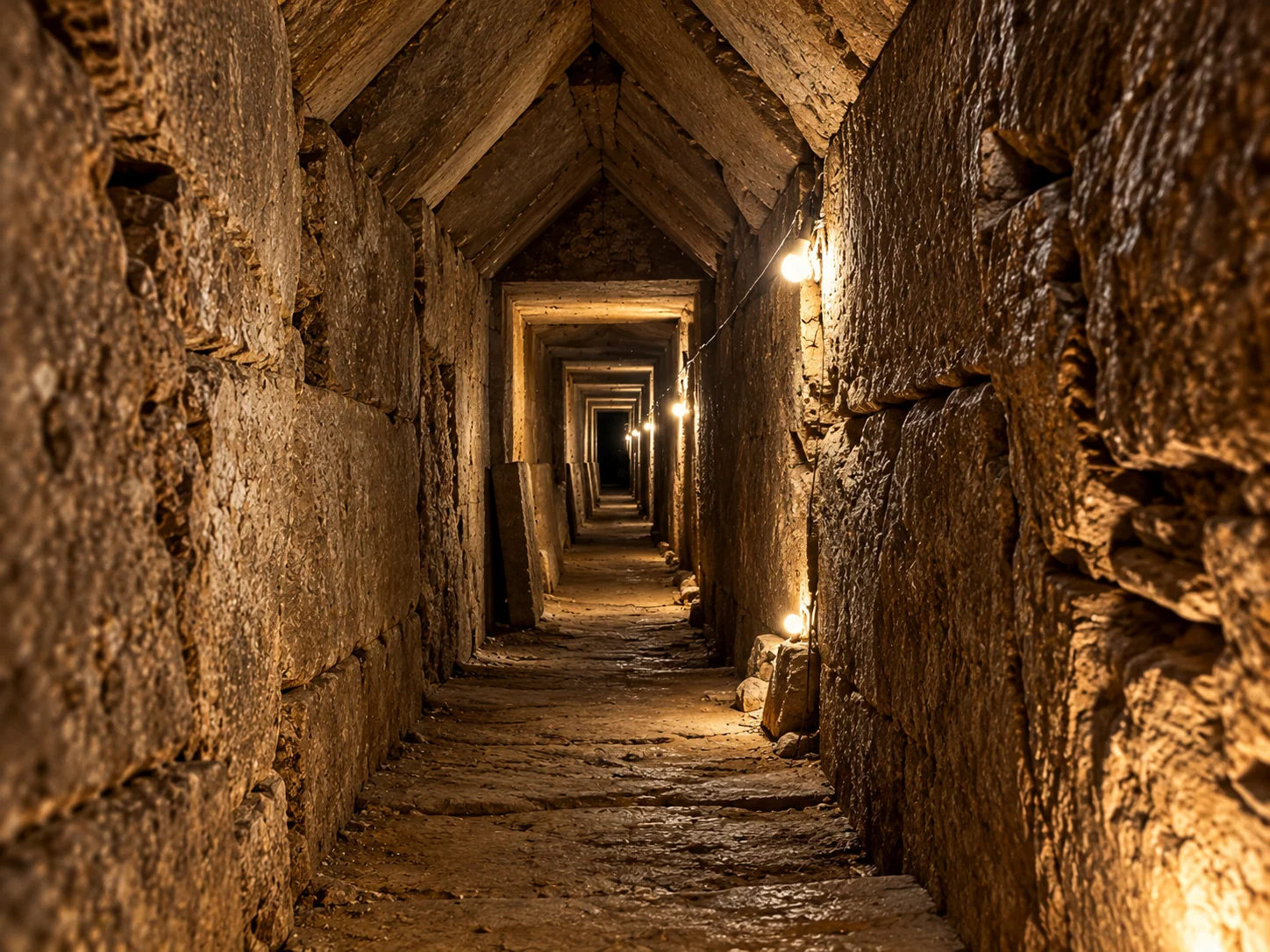
One thousand three hundred and five meters is more than a kilometer. The tunnel we are talking about measures 1,305 meters, carved into the rock beneath a temple near Alexandria, Egypt. Architecture experts have called it an "engineering miracle." Someone, in a distant era, dug such a long passage to bring someone or something somewhere.

Where? The question has an answer that divides opinion. For the team working on the site, that corridor could lead to the lost tomb of Cleopatra, the last queen of Egypt. The source we consulted is cautious: the tunnel "could" lead there. It does not say it has.

Before following it, it is wise to understand who is searching and where.

A Temple Near Alexandria

The source places the site near Alexandria but does not name it. Other accounts identify it as Taposiris Magna, an ancient temple dedicated to Osiris, god of the dead, from the Ptolemaic era. The name needs to be verified, but the context is significant: Osiris is the ruler of the Egyptian afterlife, and the queen who called herself the new Isis, his spouse, would have had good religious reasons to be linked to such a place.

This is the basic idea, and it is an idea attributed to those who support it, not a fact. The historical Cleopatra died in 30 BC. Ancient sources, including Plutarch, say Octavian allowed her to be buried next to Mark Antony. No one has ever identified that tomb. The exact location, two millennia later, remains one of archaeology's great mysteries.

The Archaeologist Digging Since 2005

The name given by the source is Kathleen Martinez. The report identifies her as one of the archaeologists working at the site and does not explicitly say she leads the research. However, it says one thing clearly: her hunt for Cleopatra's tomb began in 2005.

Other accounts describe her as a Dominican archaeologist and as the figure who first supported the hypothesis of the Osiris temple. This information needs verification. What matters is the duration: since 2005 at the same site, without giving up, pursuing an idea that most of the scientific community initially treated as a bold hypothesis.

Meanwhile, the excavations have yielded something. Not the tomb. Something uncomfortably similar.

The Evidence: Shrines, Lake, and Coins

The report lists what has come to light. A religious center with three shrines. A sacred lake. Statues. Gold. And a collection of coins bearing Cleopatra's face.

The coins are the detail that sparks imagination, and also the one to handle with the most care. A coin with a queen's face proves that face circulated in that place. It does not prove that the queen is buried there. Ptolemaic coinage was widespread, and the presence of coins with her image in a site of her kingdom is, by itself, a predictable fact.

Then there is the tunnel: 1,305 meters of corridor, called an "engineering miracle" by architecture experts. Such works are not made without a reason, and the reason must be great. Nothing in the source explains the purpose for which it was dug. Every answer today is a hypothesis.

Tombs That No One Finds

Egypt's history is full of lost tombs. The tomb of Alexander the Great, which was a pilgrimage site in Alexandria for centuries, has vanished from sources without leaving an address. In the city, ancient chronicles speak of earthquakes, waves, revolts, and collapsed buildings. Part of the royal district now lies under the sea.

The most famous rediscovery case remains Tutankhamun in 1922: the tomb of a minor pharaoh, almost intact because it was buried under the rubble of another tomb. A queen like Cleopatra, the last, the most debated, has an opposite fate. Her name is in every book, but her tomb is on no map.

Those supporting the research at the Osiris temple start from here: if the tomb is not under the sea, it must be in a place no one has ever thought to search.

Hypotheses and Objections

The theory of the tomb in the temple is fascinating and, for now, unproven. The source does not say the tunnel has been fully explored, does not say a burial chamber has been found, and does not say there are human remains. Many Egyptologists, as a rule, remain cautious: until inscriptions, sarcophagi, or identifiable remains emerge, the name Cleopatra remains a hope.

There is also the cautious explanation: such a long tunnel under a temple could have ritual or engineering functions, like a drainage channel, a processional route, a connection to the sacred lake. These are hypotheses attributed to the more skeptical scholars, not conclusions.

Finally, there is the legend. Ancient sources tell that the queen died from the bite of an asp, and there are still those who doubt the accuracy of the story. Others, outside academia, claim that the priests of Osiris hid the tomb precisely to protect it from the Romans. These are voices, not facts.

Why It Matters

Because Cleopatra is the most famous queen of antiquity and, paradoxically, one of the least known. We know how her Roman enemies told her story. We know little about how she wanted to be remembered by herself.

The source writes it plainly: if the tunnel really leads to her tomb, it could be the most important discovery of the century. It is a journalist's phrase, but it rests on a truth: the burial of a sovereign of her rank, intact or almost, would give us inscriptions, objects, perhaps even remains.

A warning. Our source is an educational text and does not include images, discovery dates, or direct statements from the excavators. Before taking any detail for certain, it should be compared with official communications from the Egyptian authorities.

The Last Deception

Those who support the temple theory draw a disturbing consequence. The woman who defied Rome in life would have defied Rome in death as well: choosing a temple of Osiris, the god of the dead, would mean being buried as a goddess, far from those who wanted her defeated and forgotten.

Two thousand years later, no one has proof that this happened. Under that temple runs a 1,305-meter gallery and, for now, at the end, there is only a conditional.